5 signs it's time to switch 3PL providers (and how the Fulfillment Freedom Fund can help)


Table of contents
Talk to a fulfillment consultant today
TL;DR:
- Brands often stay with a bad 3PL provider longer than they should because it's easier to justify the cost of staying than switching
- Common signs it's time to swreitch 3PL providers: rising shipping costs, carrier over-reliance, poor inventory visibility, inability to scale, and never running a 3PL RFP
- The Fulfillment Freedom Fund offers eligible brands up to $50,000 to help offset the cost of switching 3PL providers*
A 3PL provider that works well at one stage of growth doesn't always keep working at the next. Order volume increases, new sales channels get added, and shipping requirements get more complex—and a provider built for where you were can quietly become a constraint on where you're headed.
But what happens when you're locked in?
Below, we dig into the drawbacks of staying with the wrong 3PL, when it's time to switch (even if you’re locked into a contract), and how to offset the cost of switching with a first-of-its-kind transition support program: the Fulfillment Freedom Fund.
The hidden math of staying
Every brand that outgrows its 3PL provider is running a quiet cost comparison, whether they realize it or not.
On one side: the cost of staying. Shipping rates that don't scale with volume. Limited visibility into inventory and orders. A lack of internal advocacy or support as you scale (to name a few issues). This cost is real, but it's diffuse. It shows up as slightly worse margins every month, not as one number on an invoice, hidden under a contract they can’t break early.
On the other side: the cost of leaving. Termination fees. Integration work. The operational risk of moving inventory mid-quarter. This cost is concrete, upfront, and easy to point to as a reason to wait.
That asymmetry keeps brands with an underperforming 3PL provider longer than they should. The math simply doesn't add up in their favor at face value.
5 signs it's time to switch 3PL providers
Not every fulfillment headache means it's time to leave, and this list isn't exhaustive. But a few patterns tend to show up consistently in brands that have genuinely outgrown their 3PL provider.
Here are five signs to look for.
1. Shipping costs are rising faster than your 3PL provider can offset
Carrier pricing has gotten more complicated. Base rates, fuel surcharges, dimensional weight rules, and accessorial fees all move independently, and they compound rather than simply add up.
A 3PL provider that isn't actively rate-shopping across carriers in real time is passing more of that volatility on to you than you may realize.
2. You're overly reliant on one carrier
A single-carrier or thin-carrier-mix setup can look efficient right up until that carrier reprices, changes its dimensional weight policy, or has a capacity issue during peak season.
A 3PL provider with real multi-carrier flexibility can absorb that kind of disruption. One without it can't—and you end up absorbing it instead.
3. You have no visibility into inventory or orders until something goes wrong
If the first sign of a stockout or a shipping delay is a customer complaint or retail chargeback, your 3PL provider's systems aren't giving you the visibility you need to manage your business proactively.
You should be able to view inventory levels across every warehouse, track order status in real-time, and identify early warning signs of a delay before a customer or retail partner even notices. Better yet, your 3PL should be ahead of these problems before you are, and have processes in place to address them.
Otherwise, you're doing damage control for a problem you didn't create.
4. Your 3PL provider can't flex with your growth
A provider that worked well at 5,000 orders a month can become a genuine constraint at 30,000. New sales channels, SKU expansion, and seasonal spikes all test whether a 3PL can actually scale with you, or whether you've outgrown what it was built to handle.
This often shows up in specific ways: longer lead times during peak season, an inability to support a new channel like retail or wholesale alongside DTC, or a warehouse network that can't get you closer to new customer bases as you expand geographically.
5. You've never run a 3PL RFP to check you're still getting a competitive deal
Benchmarking your 3PL provider against the market isn't something most contracts prompt you to do regularly. But shipping rates shift more often and more unpredictably than most contracts account for—carrier pricing, fuel surcharges, and dimensional weight rules can all change well before a contract is up for renewal.
Running a 3PL RFP (Request for Proposal), or simply researching what it would take to outsource fulfillment elsewhere, is a healthy gut-check regardless of whether you're ready to switch. It's often the fastest way to find out whether your current rates and terms are still competitive.
What to look for in your next 3PL provider
If you're running an RFP or just starting to evaluate alternatives, it helps to know what separates a 3PL provider that can actually keep up with you from one that will eventually become the next constraint. A few things worth prioritizing:
- Multi-carrier rate shopping: A provider that dynamically shops rates across carriers in real time can absorb pricing volatility instead of passing all of it on to you.
- Real-time visibility: You should have a live view of inventory and order status across every warehouse, not just a report after something's already gone wrong.
- Geographic distribution: A wider network of fulfillment locations means faster, cheaper shipping as your customer base spreads out.
- Channel flexibility: Your next 3PL provider should be able to support DTC and B2B business under one system, not force you into separate workflows as you add channels.
- Transparent, scalable pricing: Look for a provider whose rates and terms are clear about how they change as your volume grows, rather than a flat structure that stops making sense past a certain size.
This is also a good gut-check for whether it's time to outsource fulfillment for the first time, not just switch providers. The same criteria apply either way.
When it's time to switch: Join the Fulfillment Freedom Fund
You may recognize any of the signs above, but choose to stay anyway, because the cost of leaving is easier to see than the cost of staying.
The Fulfillment Freedom Fund helps you break free from exactly that problem.
It's a first-of-its-kind transition support program designed to offset the cost of switching to a better fulfillment partner. Eligible brands can receive up to $50,000 in transition support, based on their monthly order volume, to help offset documented costs like termination fees, integration and implementation work, and inventory transfers.*
Why we built it
We kept hearing the same objection from brands who wanted to leave their 3PL: they were locked in. Not because they didn't know their fulfillment partner wasn't working, but because the cost of breaking a contract early was what stopped them.
That felt wrong. A brand that's already decided to switch shouldn't be held in place by a termination fee.
So we built a program, not a one-off deal: a cohort where a limited group of brands gets the support they need and a genuine commitment on both sides. It exists to remove one obstacle for brands that have already made up their mind, not to convince anyone their 3PL is bad.
How it works
Joining the Fulfillment Freedom Fund is a straightforward, three-step process:
- Apply: Submit your application, and Flowspace reviews your fit.
- Get your numbers: Every complete application receives a free Network Optimization Analysis—a real savings estimate and warehouse recommendation—whether or not you're accepted into the program.
- Join and start saving: If you're accepted, you sign your agreement and begin capturing your approved fund amount as credits over the course of your 15-month partnership with Flowspace.
Why Flowspace
The fund makes switching accessible. But what you're switching to is what makes it worth it.
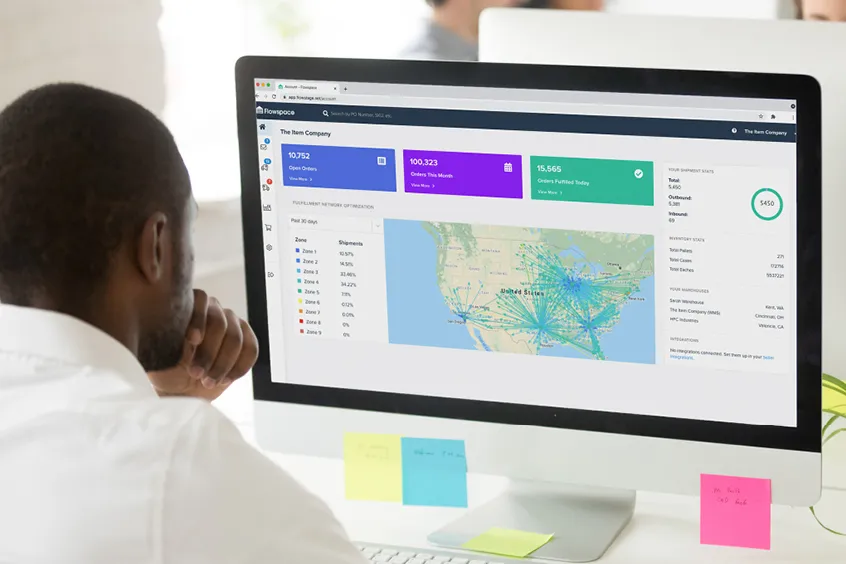
Flowspace pairs coast-to-coast fulfillment centers across the U.S. and Canada with a platform built for real-time rate shopping across carriers, smarter inventory placement, and AI-supported automation and visibility into every order and unit of inventory.
"Brands should choose the fulfillment partner that's best for their business, not the one they're financially locked into," said Ben Eachus, CEO and Co-founder of Flowspace, in the program's launch announcement.
That philosophy shows up in the results. Flowspace customers have saved up to 20% on shipping costs through the same rate-shopping and inventory placement built into the platform.
As Eachus put it: "Our customers consistently tell us they wish they'd switched sooner. This program is about giving brands the confidence to move forward by removing one of the biggest obstacles to choosing a fulfillment partner that's built to help them grow."
Ready to make the switch?
If you recognized your own 3PL setup in any of the signs above, you've probably already done the hard part. The Fulfillment Freedom Fund exists to handle the rest.
Applications are open through September 30, 2026. Apply today to see what you qualify for.
FAQ
How do I know if it's time to switch 3PL providers?
The clearest signs are rising costs your provider can't explain, over-reliance on a single carrier, poor visibility into inventory and orders, an inability to scale with your growth, and never having benchmarked your rates through a 3PL RFP. If more than one of these applies to your business, it's worth evaluating alternatives.
What does it cost to switch 3PL providers?
Switching costs typically include early termination or contract buyout fees from your current provider, integration and implementation costs, and inventory transfer expenses. These costs vary by brand and contract, which is why programs like the Fulfillment Freedom Fund exist to help offset them.
What is the Fulfillment Freedom Fund?
The Fulfillment Freedom Fund is a first-of-its-kind transition support program from Flowspace that offers eligible brands up to $50,000, based on monthly order volume, to help offset the cost of switching 3PL providers.*
Who is eligible for the Fulfillment Freedom Fund?
Brands that average at least 1,000 orders a month, currently use another 3PL, self-fulfill, or operate under a warehouse lease, and are organized and operating in the U.S. may be eligible to apply.
Do I need to run a 3PL RFP before switching providers?
It's not required, but it's a useful step. A 3PL RFP helps you benchmark your current rates and terms against the market, so you can confirm switching is the right call, not just a guess.
How long does it take to switch 3PL providers?
Timelines vary by brand and complexity, but the process generally starts with an application and a free savings analysis, followed by onboarding and integration once you've selected a new provider.
*Fund amounts are up to $50,000 based on your monthly order volume. Terms and conditions apply—see T&Cs for full eligibility criteria and program details. Results may vary.
Last Updated
category
Related articles



















Start simplifying fulfillment with Flowspace today
Discover how Flowspace can simplify fulfillment and help your brand scale faster, with no long-term contracts or hidden commitments.
