AI agents for logistics: How they're changing fulfillment operations
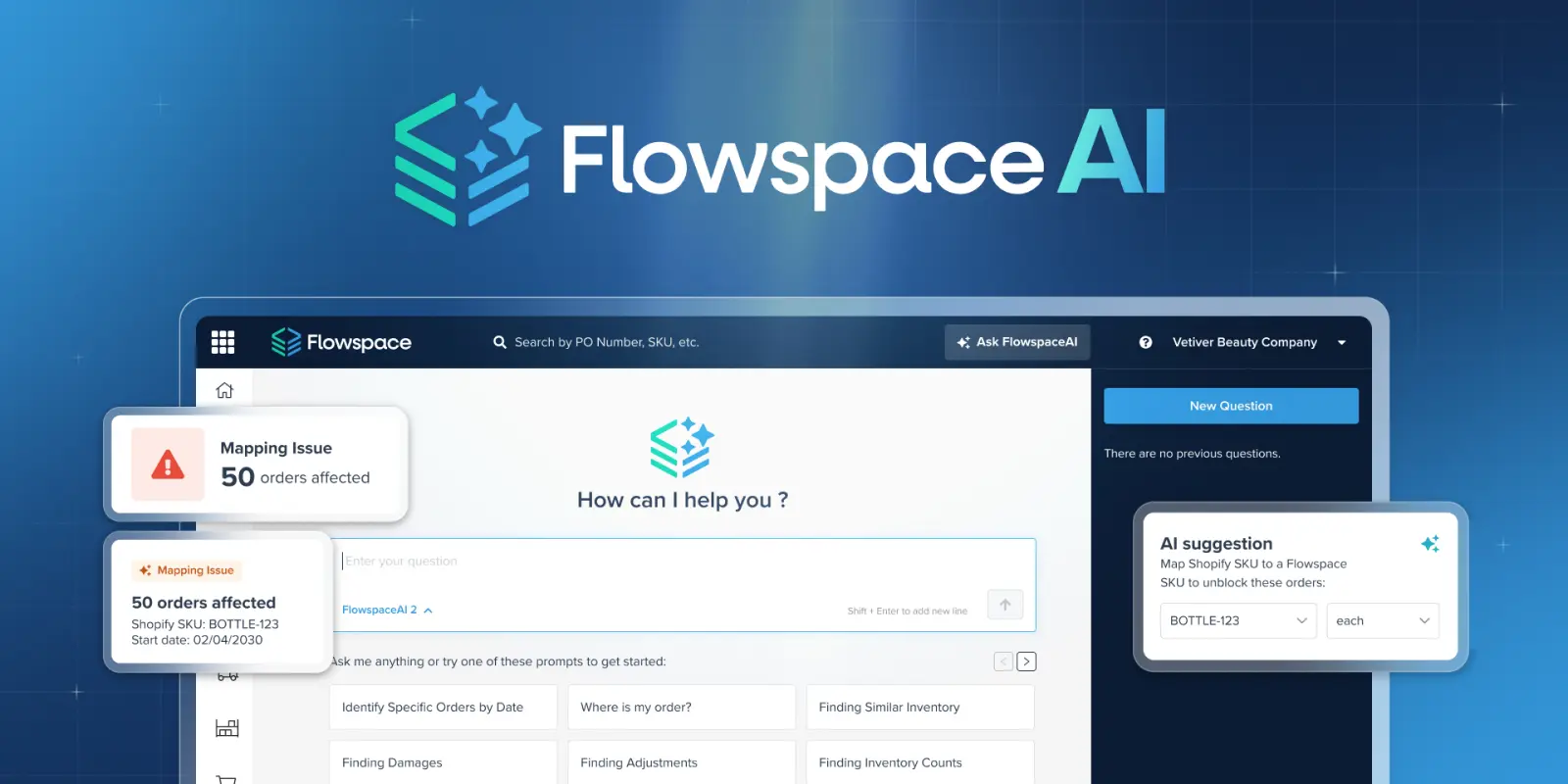

Table of contents
Talk to a fulfillment consultant today
TL;DR
- AI agents for logistics go beyond traditional alerts by investigating operational issues, analyzing data, and recommending simple next steps.
- In Flowspace fulfillment, AI agents help diagnose stalled orders, shipping errors, carrier exceptions, and more—reducing blockers and saving significant time for ops teams.
- As the technology advances, agents are moving beyond recommendations to support more routine actions and automated workflows.
Logistics operations depend on thousands of moving parts. Within fulfillment, warehouse teams coordinate incoming inventory, orders move between systems, and carriers navigate changing delivery conditions.
Keeping everything running requires constant monitoring, coordination, and decision-making.
AI agents for logistics are changing how teams manage that complexity. By analyzing operational data, monitoring workflows, and taking on repetitive tasks, these systems help businesses respond faster and manage growing demands with less manual intervention or additional headcount.
From warehouse operations and inventory management to transportation and fulfillment, agentic AI is opening new opportunities to make logistics more efficient, connected, and scalable.
What are AI agents for logistics?
AI agents for logistics are software systems that use artificial intelligence and connected operational data to perform tasks across logistics and supply chain operations, such as fulfillment. Unlike traditional chatbots that mainly answer questions, these agentic systems can proactively monitor workflows, investigate issues, and recommend or execute actions.
For example, when an order stops progressing, an AI agent can examine relevant order and inventory information, identify potential blockers, and recommend a fix—or take an authorized action automatically.
Technologies like Model Context Protocol (MCP) are also expanding what's possible. By connecting AI agents to logistics platforms, businesses can analyze operational data, generate reports, and even build custom dashboards and interfaces tailored to their specific needs.
Agents vary in their level of autonomy. Some focus on investigation and decision support, while others execute tasks within established rules and permissions, with human oversight where required.
How do AI agents work in fulfillment?
Traditional fulfillment software already provides valuable visibility into orders, inventory, and shipping. Dashboards display performance, alerts surface exceptions, and automation rules help manage predictable workflows.
AI agents build on those capabilities by doing more of the investigative work.
Consider an order that hasn't shipped.
A traditional alert might tell an operations manager that the order requires attention. The manager then needs to review its status, check inventory, look for errors, and determine why fulfillment has stalled.
An AI agent can help connect those steps.
1. Detect an operational issue
The process starts with a signal, such as a stalled order, failed shipping label, or carrier-reported exception.
Depending on the system, the investigation may begin automatically when a defined condition occurs, rather than waiting for someone to request it.
2. Investigate the available information
The agent examines relevant operational data to understand what happened.
That might include order details, inventory availability, shipping configurations, error messages, or carrier tracking information.
Instead of requiring someone to gather these details manually, the agent brings the available context together.
3. Recommend what happens next
Based on its findings, the agent can explain the likely cause and recommend an appropriate next step.
Sometimes the answer is straightforward. Other times, the available information may be insufficient, requiring additional investigation or human judgment.
The goal is to reduce the time between detecting an issue and knowing how to address it.
How are AI agents used across logistics?
AI agents are being applied across the supply chain, from warehouse operations to inventory planning and transportation. By analyzing data from connected systems, they can help logistics teams anticipate disruptions, coordinate activities, and make faster operational decisions.
Warehouse operations
AI agents can help warehouse teams identify picking bottlenecks, monitor inbound shipments, and prioritize tasks based on order volume and fulfillment deadlines. By analyzing warehouse activity, they can also recommend workload adjustments to improve efficiency and keep orders moving.
Inventory management
Managing inventory across locations and sales channels requires accurate data and constant coordination. AI agents can analyze stock levels, flag potential shortages or discrepancies, and recommend replenishment or inventory reallocation based on demand. These capabilities help teams address availability issues before they disrupt fulfillment.
Transportation and shipping
AI agents can monitor shipments, evaluate transportation delays, and analyze carrier performance to identify potential disruptions. They can also support route planning, recommend alternative shipping options, and help logistics teams adjust to changing delivery conditions.
These applications demonstrate how agentic AI can support different parts of logistics operations. In order fulfillment specifically, agents are already helping teams investigate and respond to the exceptions that affect individual orders.
Where AI agents can make a difference in fulfillment
From order processing to final delivery, fulfillment involves countless decisions and operational dependencies. AI agents can help teams manage these interconnected workflows, spot disruptions, and reduce repetitive manual work.
Order processing and prioritization
AI agents can monitor order activity, identify stalled workflows, and flag shipments that need attention. By helping teams prioritize exceptions, they can reduce processing delays and keep orders progressing toward fulfillment.
Shipping and label management
Shipping errors, service restrictions, and incorrect package information can interrupt fulfillment. AI agents can analyze shipping data, identify potential problems, and recommend adjustments to help orders move through the shipping process.
Delivery monitoring and exceptions
AI agents can analyze tracking updates, flag delivery disruptions, and help teams prioritize shipments that require follow-up. This gives operations teams greater visibility into delivery performance and helps them respond faster when problems arise.
Inventory availability
AI agents can analyze stock availability, identify potential shortages, and highlight inventory constraints that may affect order fulfillment. These insights help teams make informed inventory decisions and reduce the risk of unfulfilled orders.
From reactive alerts to proactive fulfillment operations
AI agents reduce the manual work involved in investigating fulfillment issues, helping teams uncover causes and resolve problems faster.
When order volume increases, the number of exceptions requiring attention can increase too. Each investigation takes time, even when the underlying issue is relatively routine.
AI agents offer a different approach.
Instead of assigning someone to investigate every issue from scratch—or requiring additional headcount as orders grow—operations teams can use agents to gather context, evaluate likely causes, and prepare recommendations.
This can help teams:
- Reduce repetitive investigation and troubleshooting
- Respond to operational exceptions with more complete information
- Prioritize issues that require attention or human judgment
- Support growing order volumes without proportionally increasing manual exception-management work
Importantly, proactive fulfillment doesn't mean every issue is prevented or automatically resolved. It means teams have a better way to identify, understand, and respond to problems as they arise.
What's next for agentic AI in logistics?
Today, much of the practical value of agentic AI comes from investigation, explanation, and decision support.
The next stage is moving from recommendations toward more routine operational actions.
For example, an agent that identifies a shipping configuration issue could eventually help prepare or carry out an approved correction. Another might support a replacement workflow after a carrier confirms that a package is lost.
The level of automation matters.
Routine, well-defined tasks may be suitable for pre-authorized actions. Decisions involving customer commitments, order changes, or financial consequences may require explicit approval.
Connections between AI assistants and logistics systems will also become increasingly important. Technologies such as Model Context Protocol (MCP) can help compatible AI tools access authorized operational information, opening possibilities for more connected workflows.
How FlowspaceAI brings AI agents into fulfillment operations
At Flowspace, we're putting AI to work on the operational problems that fulfillment teams encounter every day.
FlowspaceAI includes agents that proactively investigate supported exceptions, including backorders, shipping label failures, and carrier-reported issues.
Rather than stopping at an alert, these agents examine relevant information, identify likely causes, and surface solutions. When needed, Flowspace's operations experts use those findings to make informed decisions and address issues.
FlowspaceAI also gives brands a way to ask questions about orders, inventory, and shipments directly through the fulfillment platform, reducing the need to manually search through reports.
Together, these capabilities bring AI-powered intelligence closer to the physical operations behind every order.
The long-term opportunity is fulfillment that can handle increasing complexity through technology, without requiring the same increase in manual operational work.
Explore FlowspaceAI to learn how we're bringing AI into modern fulfillment operations.
Frequently asked questions about AI agents for logistics
What is the difference between AI agents and traditional logistics automation?
Traditional automation generally follows predefined rules to complete specific tasks. AI agents can go further by using available information to investigate problems, evaluate possible causes, and determine next steps. Some agents can also carry out authorized actions.
Can AI agents automatically resolve fulfillment issues?
Some AI systems can perform routine actions automatically, depending on their capabilities and configured permissions. Others focus on investigating issues and recommending solutions. Actions that affect orders or customer commitments may require human approval.
How can AI agents improve order fulfillment?
AI agents can help investigate stalled orders, diagnose shipping errors, interpret carrier exceptions, and support inventory-related decisions. These capabilities reduce repetitive troubleshooting and help teams respond to operational issues more efficiently.
Will AI agents replace fulfillment operations teams?
AI agents can reduce the manual work involved in monitoring, investigating, and responding to routine exceptions. Human expertise remains important for complex operational decisions, unusual circumstances, and actions that require approval.
Last Updated
category
Related articles



Start simplifying fulfillment with Flowspace today
Discover how Flowspace can simplify fulfillment and help your brand scale faster, with no long-term contracts or hidden commitments.
