AI commerce in ecommerce: Personalization, technology, and the future of retail


Table of contents
Talk to a fulfillment consultant today
Updated September 2026
For more than a decade, retail innovation was defined by digitization. Brands invested in ecommerce platforms, expanded omnichannel capabilities, and optimized checkout experiences. The goal was simple: meet customers wherever they are.
But digital transformation was only the first phase.
Today, a more fundamental shift is underway. AI commerce is reshaping how teams forecast demand, personalize interactions, and coordinate inventory and fulfillment across increasingly complex networks. This evolution is not just about automation. It is about intelligence embedded across every layer of commerce operations.
At the same time, consumer expectations continue to rise. In the United States, shoppers expect fast shipping, relevant recommendations, and seamless experiences across channels. Meeting those expectations increasingly requires AI-driven systems that can adapt in real time.
The future of shopping will not be defined by storefronts or even websites. It will be written in data.
What AI commerce means in ecommerce
AI in ecommerce refers to the use of machine learning, predictive analytics, automation, and intelligent algorithms to enhance both customer experiences and operational performance.
But AI commerce goes further.
It transforms operational and behavioral data into a continuous learning system. Every click, purchase, inventory change, order event, and return can feed models that improve decision-making over time.
In practice, this transformation is still evolving. Many brands deploy AI across individual functions, such as product recommendations or pricing support, but fully integrated systems that connect the entire commerce lifecycle are still emerging.
When implemented effectively, AI commerce can help:
- Deliver more personalized shopping experiences
- Forecast demand with greater precision
- Inform pricing strategies
- Improve inventory allocation across fulfillment networks
- Reduce waste and excess discounting
AI is no longer just a marketing enhancement. Increasingly, it is becoming a core capability that connects merchandising, ecommerce, and supply chain management.
The evolution of AI technologies in retail
Early retail AI focused on simple recommendation algorithms and rule-based automation. These systems could suggest products based on past purchases or common buying patterns, famously captured in the phrase, “Customers who bought this also bought.”
Today’s AI systems are far more predictive and data-driven. Modern models analyze signals such as:
- Cross-channel browsing behavior
- Purchase frequency and replenishment cycles
- Price sensitivity
- Geographic demand patterns
Instead of reacting only to past transactions, these systems are increasingly built to anticipate future behavior.
This evolution marks a shift from reactive commerce to predictive commerce.
The question is no longer simply, “What is the customer searching for?”
It is increasingly, “What will the customer need next?”
The role of customer behavior analysis
A key part of AI commerce is advanced customer behavior analysis.
Retailers now collect enormous amounts of behavioral data across websites, apps, marketplaces, and physical locations. The advantage lies not just in collecting that data, but in identifying meaningful patterns within it.
Behavior analysis allows brands to:
- Anticipate churn before it happens
- Predict replenishment timing
- Identify high-value customer cohorts
- Detect shifts in customer preferences
Rather than relying on static segmentation, AI systems can group customers dynamically based on behavioral signals and evolving patterns.
As a result, two customers may visit the same website yet encounter different recommendations, promotions, and merchandising experiences.
Tools and techniques behind AI commerce
Modern tools supporting AI commerce include:
- Machine learning models for churn prediction
- Lifetime value (LTV) modeling
- Real-time personalization engines
- Behavioral clustering algorithms
- Sentiment analysis from reviews and customer service interactions
Together, these technologies move personalization beyond surface-level customization and toward more predictive, data-informed decision-making.
Data-driven decision-making in retail
Traditional retail marketing has long relied on campaigns, seasonal pushes, and fixed promotional calendars. AI commerce is shifting that model toward continuous optimization, where decisions can be adjusted in response to real-time data.
Through data-driven decision-making, brands can:
- Deliver individualized offers in real time
- Inform pricing strategies based on demand signals and market conditions
- Personalize product bundles and cross-sell opportunities
- Optimize the timing of communications and promotions
Personalization is no longer just a front-end tactic. It increasingly shapes how brands plan demand, merchandising, and customer engagement.
As that personalization becomes more sophisticated, marketing decisions begin to converge with operational systems such as inventory planning and fulfillment capacity.
Demand signals and operational alignment
One of the most important shifts in AI commerce is the ability to connect demand signals with operational decision-making.
When behavioral insights, marketing activity, and purchasing trends inform inventory planning and fulfillment strategies, retailers can:
- Prevent stockouts
- Reduce excess inventory
- Protect margins
- Position products closer to expected demand
Historically, marketing and operations often worked in parallel but not always in sync. Promotions could drive demand faster than supply chains could respond, creating stockouts, delays, or costly markdowns.
AI-driven systems help close that gap by linking demand signals with inventory positioning, order planning, and fulfillment readiness.
This alignment between demand generation and execution is where AI commerce starts to create meaningful competitive advantage.
AI and fulfillment intelligence: The Flowspace perspective
For AI commerce to deliver on its promise, intelligence has to extend beyond the digital storefront. It also has to improve what happens after the customer clicks “buy.”
That includes the operational decisions that determine whether an order can be fulfilled accurately, efficiently, and on time: where inventory is positioned, how orders are prioritized, when exceptions are flagged, and how teams respond to changes across the network.
This is where fulfillment becomes a critical part of the AI commerce conversation.
A brand may have strong signals about what customers are likely to buy, but without visibility into inventory, order status, shipments, and exceptions, that intelligence remains incomplete.
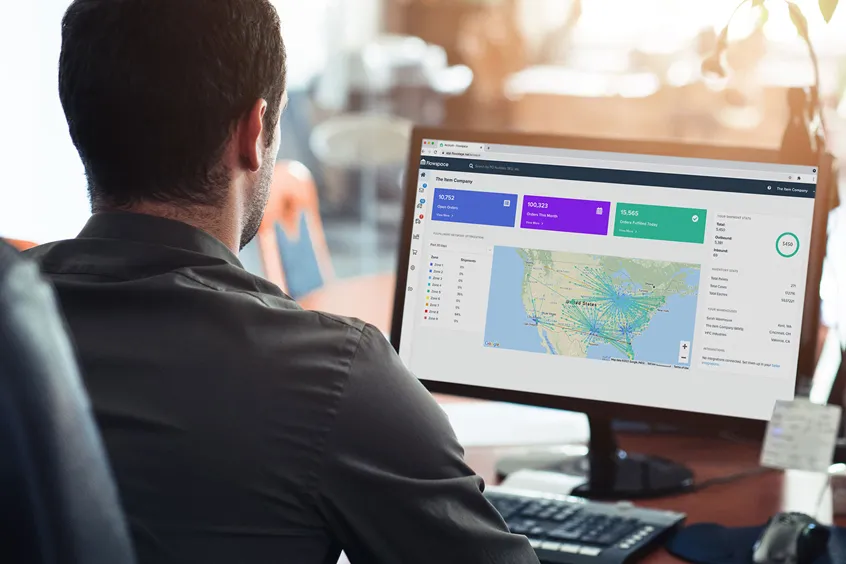
At Flowspace, this is where AI strives to create practical value for brands as commerce advances. FlowspaceAI helps automate operational workflows and gives users better access to the data behind inbound and outbound orders, parcel shipments, and inventory. It also supports guided interactions, enables simple action-taking, and incorporates user feedback to improve future responses. For a broader look at how these technologies are reshaping the movement of goods, explore our perspective on AI in logistics and transportation.
Rather than treating AI as a standalone feature, fulfillment that scales uses it to reduce manual work, improve visibility, and help teams make faster operational decisions.
In that sense, AI commerce is not only about influencing demand. It is also about making fulfillment operations more responsive, more informed, and better aligned with the realities of execution.
Challenges and opportunities in AI commerce
Despite its potential, many brands still struggle with AI adoption because of fragmented data systems, legacy infrastructure, organizational silos, and limited cross-functional alignment.
AI cannot operate effectively on disconnected systems. The teams that gain the most from AI commerce will be the ones that treat data as a strategic asset and connect customer signals with operational execution.
That means bringing marketing, inventory, fulfillment, and customer insights into a more unified intelligence layer.
Future trends in AI and ecommerce
Several trends are likely to shape the next phase of AI commerce in the U.S. market:
- AI shopping agents: Consumers are beginning to rely on AI assistants to compare products, evaluate reviews, and support purchase decisions. As that behavior grows, brands will increasingly compete for algorithmic preference, where structured product data, fulfillment reliability, and pricing transparency influence visibility.
- Adaptive pricing strategies: Pricing will become more responsive to demand patterns, inventory conditions, and market dynamics, helping brands balance conversion goals with margin protection.
- Always-on optimization: Quarterly campaign cycles will continue to give way to more continuous, AI-supported decision-making across promotions, merchandising, and customer engagement.
- Closer alignment between growth and operations: Retailers will increasingly align marketing campaigns with inventory availability and fulfillment capacity, ensuring they promote products they can deliver efficiently.
- Greater scrutiny around data use and transparency: As AI commerce matures, brands will face rising pressure to be clear about how data is used, how pricing and personalization are applied, and how customer trust is protected. A growing patchwork of U.S. state privacy laws, along with broader emphasis on transparency and trustworthy AI, will make this an increasingly important part of commerce strategy.
The path forward in AI commerce
AI commerce is not simply about better recommendations or smarter ads. It represents a broader shift in how retail operates.
The future of personalized shopping depends on:
- Unified data infrastructure
- Real-time intelligence across the value chain
- Predictive demand modeling
- Closer coordination between marketing, inventory, and fulfillment
Brands that treat AI as a tool layered onto legacy systems will see incremental gains. Meanwhile, teams that build more connected, intelligence-driven operations will be better positioned to shape the next era of commerce.
For that shift to work, operational orchestration matters. Personalization cannot stop at the point of click. It has to carry through to what happens behind the scenes, including at the fulfillment level.
At Flowspace, we see that as a major part of the future of AI commerce. Through FlowspaceAI, we are continuing to embed AI into more of our platform to help brands save time and money, automate operational workflows, reduce errors, flag exceptions that need support, and make logistics more reliable every day.
AI commerce is not just about smarter recommendations. It is about turning intelligence into execution.
AI commerce FAQ
What is AI commerce in ecommerce?
AI commerce in ecommerce refers to the use of artificial intelligence, machine learning, predictive analytics, and automation to improve both customer experiences and retail operations. It helps brands personalize shopping, forecast demand, optimize pricing, and make smarter inventory and fulfillment decisions.
How is AI commerce different from traditional ecommerce automation?
Traditional ecommerce automation usually relies on fixed rules and repetitive workflows. AI commerce goes further by using data to learn over time, predict outcomes, and support dynamic decision-making across merchandising, marketing, inventory, and fulfillment.
How does AI improve personalized shopping experiences?
AI improves personalized shopping by analyzing customer behavior, preferences, purchase history, and browsing patterns to deliver more relevant product recommendations, offers, bundles, and messaging in real time.
What role does customer behavior analysis play in AI commerce?
Customer behavior analysis helps brands identify patterns such as churn risk, replenishment timing, product interest, and changing preferences. That insight allows retailers to adjust merchandising, promotions, and engagement strategies based on real customer signals.
How can AI support demand forecasting and inventory planning?
AI can improve demand forecasting by analyzing historical sales, browsing activity, geographic demand patterns, seasonality, and other signals. This helps brands reduce stockouts, avoid excess inventory, and position products closer to expected demand.
Why does fulfillment matter in AI commerce?
Fulfillment matters because AI commerce does not end at the point of purchase. To deliver on customer expectations, brands need inventory visibility, order tracking, exception management, and responsive fulfillment operations that align with demand signals.
What are the biggest challenges of adopting AI commerce?
Common challenges include fragmented data systems, legacy technology, organizational silos, and limited alignment across marketing, operations, and supply chain teams. AI works best when brands connect data and decision-making across functions.
What trends are shaping the future of AI commerce?
Key trends include AI shopping agents, adaptive pricing, always-on optimization, tighter alignment between growth and operations, and greater focus on transparency, trust, and responsible data use.
Last Updated
category
Related articles


Start simplifying fulfillment with Flowspace today
Discover how Flowspace can simplify fulfillment and help your brand scale faster, with no long-term contracts or hidden commitments.
