About this episode
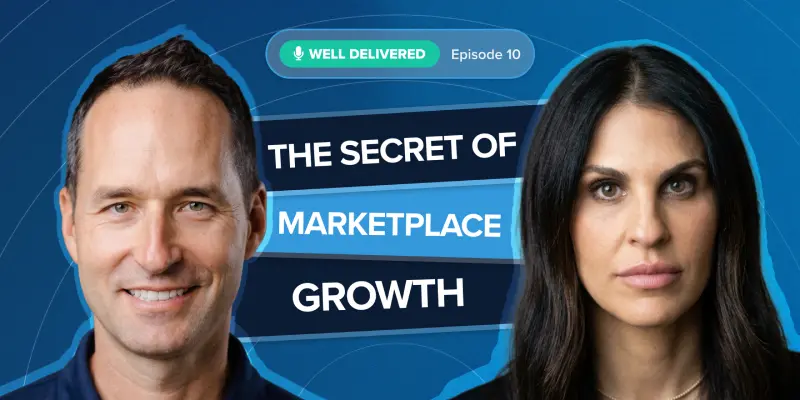
Brand growth takes more than a strong mission. In this episode of Well Delivered, Flowspace CEO Ben Eachus speaks with Lauren Gropper, Co-Founder & CEO of Repurpose, about building a sustainable consumer products brand that can grow across retail, ecommerce, supply chain disruption, and changing consumer expectations.
Lauren shares how Repurpose grew from a simple idea to replace single-use plastic into a trusted brand known for plant-based, non-toxic household essentials. Our exclusive conversation explores what brand growth really requires: products that perform, retail launches that start small before scaling nationally, strong partner relationships, resilient supply chains, and a clear promise consumers can trust.
Key takeaways
- Brand growth depends on more than distribution — products still need to perform
- Starting small can help brands learn before expanding into national retail
- Resilient supply chain partners help brands navigate tariffs, freight, and disruption
- Omnichannel distribution can reduce risk and support long-term brand growth
- Ecommerce, AI, and product innovation remain important growth opportunities for established brands
About the guest
Lauren Gropper is the Co-Founder & CEO of Repurpose, a sustainable consumer products brand creating plant-based, non-toxic alternatives to traditional single-use household essentials.
Before founding Repurpose, Lauren built a career at the intersection of sustainability, design, and environmental impact. Her work in green building and sustainable production eventually led her to film and television sets, where she saw how much single-use plastic waste was created behind the scenes. That experience inspired the idea for Repurpose: everyday products that make sustainability easier without asking consumers to sacrifice performance, convenience, or trust.
Under Lauren’s leadership, Repurpose has grown into a widely distributed brand across major retailers and ecommerce channels, while continuing to focus on product innovation, sustainable materials, and simple swaps that help consumers make better choices.
[0:00] Ben: Welcome to Well Delivered by Flowspace, the podcast unpacking real insight for building and scaling modern supply chains. Today, we're talking about what it takes to grow a sustainable brand that earns trust and stays resilient as scaling gets more complex. Hi, my name is Ben Eches, and I'm the co-founder and CEO of Flowspace. You're listening to Well Delivered.
On our podcast today, we have Lauren Gropper, who's the co-founder and CEO of Repurpose, one of the pioneering sustainable paper products companies in the industry. So welcome, Lauren.
[0:35] Lauren: Thank you, Ben. Thanks so much for having me.
[0:37] Ben: Of course. So, Lauren, you have a super interesting background before you started Repurpose. So I would love to just hear your story. What were you doing before, and what led you to start this company?
[0:49] Lauren: Well, thank you for even saying that. I think I've always just been super interested in sustainability and the environment. I was that kid that was just always wanting to be in nature and really cared about the environment and learning about it. And the more I learned about it, the more I wanted to have an impact and have a career in making sure sustainability could be a big part of my life and my career, and that I could do something to make the world a better place.
So I studied environmental studies and geography in undergrad, and then I didn't know what I was going to do. I tried so many things, like most people out of college. It's rare, I think, to go right into what you studied or to even do something in what you studied—
[1:33] Ben: Sure.
[1:33] Lauren: —and go right into a career. But I went into environmental policy work, and then I realized, oh, I don't necessarily want to do policy. I was actually working at the United Nations Environmental Program, and I just want to do something more hands-on.
I ended up doing quite a bit of global travel. I did this Peace Corps thing that was a Canadian Peace Corps, a job that was in Costa Rica, and I got to work in the eco-tourism space there. So I knew I like being more hands-on and doing something outside of the policy world.
But I still was like, I don't know what it is. And I did some more travel, got really interested in design and architecture, and through that realized that there's this whole space of green building and green design, and found a program, actually, in New York at Pratt, that focused on sustainable design. So I went to their school of architecture. I did urban design and planning and environmental design.
So what that means, the long and short of it is, you study how to create buildings and neighborhoods that are very different than the traditional way of doing it, and you do it in a much more sustainable way.
So using both technology and architectural techniques to make sure that you use less energy, less water, that the buildings themselves are designed to be super efficient and not have a negative impact on the environment. Because I didn't know, actually, that to operate a building, all the heating and cooling, it uses a lot of energy, emits a lot of greenhouse gases. So if you can do that better, you're doing a lot for the environment.
So anyway, that's why I did that. I ended up working in New York — sorry, this is such a long story — ended up in New York, after I graduated, doing green building work.
So I worked with developers who develop big buildings and build them. I worked with contractors to try and create a more green building than what they were used to creating. So there was a lot of education, and we were pioneering new technologies. It was actually amazing. And then as time went on, it became more the norm, and it wasn't as cutting-edge and pioneering, so I was starting to feel like, maybe what's next.
And then I got this random opportunity to host this green TV show in Toronto, where my sister lives — I'm Canadian, so it was fun to go back there. And then, because of that, I had done a lot of different work with people just building homes, not necessarily commercial buildings, it was homes. And that led me to meet an actor who was building a home in Brooklyn, who at the time was starring on a television show in LA, and thought that the studios could really use some greening in terms of how the sets are built and designed.
And so I came out to LA, did some work with him on the show "Entourage." This is totally aging me. But anyway, worked on that show to make it more green, consulted on some other shows, worked with Discovery Networks and Food Network, Travel Network, and everything like that to look at how they design their sets. And that's how I got to LA, and the Repurpose moment was really being on the sets.
We were looking to design a more green set, but then when you're on the set, you actually use a lot of plastic all day, every day, because you're constantly breaking, you're constantly eating, and there's no time to sit and have a meal with proper dishes—
[4:48] Ben: Sure.
[4:48] Lauren: —and everything. So it's plastic water bottles, plastic bowls, plastic forks, all day, every day. And that's when I started really digging into, well, couldn't we use a better material? Why are we using plastic to make these throwaway materials? I thought plastic was made to be durable and last forever. And that's when I had the idea for Repurpose.
[5:07] Ben: That's amazing. From designing buildings to a film set to now running a company that is producing products that are in most of our homes. The one question I had for you is, building any type of products company is difficult, but you're starting in — remind me, what year did you start the company?
[5:24] Lauren: We created the trademark on the brand in 2010, and we hit the market end of 2011 or early 2012.
[5:35] Ben: Wow. So a long time ago, before sustainable was the buzzword that it is now. So what was your first step? How did you go about building the prototype and then seeing if someone wanted to actually buy this? What did that look like?
[5:51] Lauren: It was honestly crazy, Ben. I think looking back, I don't know why — it was so naive to think that we could really do this, and I think it does take a lot of naivete to start a company because you—
[6:05] Ben: Sure.
[6:05] Lauren: —think you can do it before you know what the hell's going on. And so we were just so naive, and we thought, "Of course, who wouldn't want this? Of course, it's just going to be a success." So it really was about, yes, prototyping. We had a manufacturing partner in Taiwan.
So Taiwan, back in the day, was sort of the global leader in single-use plastic reduction because they outlawed single-use plastics made from petroleum in 2006.
[6:32] Ben: Oh, okay.
[6:32] Lauren: So they had been using this kind of technology, which is very interesting. It's a plant-based technology that's done sort of at the chemistry level that mimics a plastic polymer, and so you create these beads that look like plastic beads, plastic polymers, but they're plant-based. So there's no toxins, there's no microplastics, and it behaves much like plastic. It's slightly less durable because there's a heat tolerance issue — it doesn't have the same heat tolerance as plastic — but it really can be a full replacement for plastic, and it's plant-based.
But we had done a bunch of prototyping with the Taiwanese group, found a design that we really liked that we wanted to bring to market in the US, and then just went through the kind of, "Who do we know that has ever sold anything to anyone in the US?" And this was kind of early days of D2C, of e-commerce. And so the natural thing to do is really to start in e-commerce, prove the product-market fit, and then maybe go to retail with your success story — but we didn't have an e-commerce set up, so we were like, "We're going right to retail."
[7:37] Ben: Interesting. Yeah, I didn't realize that. You started—
[7:42] Lauren: Yeah.
[7:42] Ben: —by going to brick-and-mortar retail.
[7:44] Lauren: We started — we had what's called an in-and-out, meaning you don't get a full placement, you're just kind of in for a season — with a now-bankrupt retailer called Bed Bath & Beyond, which many may know. So that really put us on the map, and it's funny because we did some PR around our technology in the cup, and the president of Bed Bath & Beyond had seen it in a trade magazine and was like, "Oh, I'd like this." And so that's how that started. And then we went, and we found — to get into retail, you use brokers mostly. They have the real estate, or they have... sorry, not the real estate — they have the retail relationships. Maybe they had worked at that retailer, now they represent brands trying to get into that retailer. But we used a broker, and we were able to get one item into Safeway Albertsons, and that kicked us off.
[8:34] Ben: That's amazing. Now, when you get into someone like Albertsons, and you're going to scale nationally — now your products are in Target, Costco, Whole Foods, pretty much any major retailer — do you have that kind of moment where you're like, "My gosh, now we need to go and execute and deliver all this product"? So, what was that like?
[8:53] Lauren: Oh my God. Like I said, we were so naive. We really didn't know what we were doing, and this was early days, before we had real professionals on the team telling us what's what. So we were trying to predict how much product we needed. Of course, it was so off.
We're ordering — and actually our first giant container of product that we ordered came in with the labels printed upside down. So that was fun.
Just everything that could go wrong did. It was such a learning curve to go from, "Oh, we're sending a few cases of product into a store for a little in-and-out," to a national launch — and also to do it with very little money in. I wouldn't recommend it. It was really a challenge, beyond.
[9:44] Ben: Any advice? Because we work with brands that essentially typically start on direct-to-consumer and then are scaling into brick-and-mortar retail, and there's just a whole host of different challenges around forecasting, safety stock, even your technology needs to change to actually execute on that. Any words of wisdom for a founder who might be watching this, and they're kind of exploring, "Hey, what would it take for me to get into the next Target or Costco?"
[10:15] Lauren: Yeah. I think to be able to prove your success on D2C first is huge. That'll give you a leg up, absolutely, when connecting with the retailer. I always say sort of start small first. So everyone, of course, wants to be in Target, and Costco, and national, and everything like that. But really, do yourself a favor and start with a regional retailer and start small, and make the mistakes there — because you will, and you will learn so much, and then you can use that to scale.
Because if you're making mistakes with a Walmart or a Target off the bat, you don't get that many chances.
[10:42] Ben: Sure.
[10:42] Lauren: And you don't want to make the mistakes with the big folks. So I really recommend finding a regional retailer, or — if you're going to connect with a national retailer, or if a national retailer reaches out to you — it's best to start in a smaller subset of stores, and they will do that. So let's say Target is 2,000-plus stores. They'll start you in maybe 200, 250, 400, something like that, and you can really kind of prove yourself.
But even before Target, I would recommend — sorry, out there, to the regional retailers who are dealing with the fumbles of new brands — it does really help to understand your cadence, your velocities, and your order patterns, and test out new software. On D2C, you have so much data. You're able to analyze and understand really well how your product moves, where it moves, where it goes, how fast.
In retail, it's harder to get your hands on that information. It's also expensive. And you have to work really closely with your buyer too, and don't be afraid to ask them for as much detail as possible on forecasting. And sometimes it can go either way. Sometimes you sell less than they think, and that's happened to us, and that's not great. And sometimes you sell a hell of a lot more than—
[11:57] Ben: Sure.
[11:57] Lauren: —they think, and you think — and that's a good problem to have, but it's also a problem to have. So it's hard. It's never perfect.
But yeah, better to kind of learn on a smaller set of stores.
[12:10] Ben: That makes a ton of sense. So walk before you run, and then you can really scale. The challenge is that likely these brands have investors, and investors want it to grow as fast as possible. And as a CEO, founder, you want to show massive growth. It's very tempting to want to do that, and I totally get it.
[12:29] Lauren: But yeah, if at all possible, just to kind of crawl, walk, run — I would recommend it.
[12:33] Ben: Sure. And Lauren, having known you for a couple of years now, I think one of the things that's always impressive speaking to you is the business has experienced a ton of change driven by macroeconomic factors.
[12:46] Lauren: Mm-hmm.
[12:47] Ben: You dealt with COVID recently, some of the tariffs. You've been in business now 16-plus years. How are you building a company that's so resilient to some of these bigger changes?
[12:57] Lauren: It's very hard. It's extremely, extremely hard. We have an amazing team — I really can't take the credit. This is my team and my co-founder, Jordan Silverman, who handles the supply chain and the supply chain issues, and he's done an amazing job. We have amazing partners. I think it's having great partners and great relationships, because you can lean on them when you need to in these kinds of times.
[13:20] Ben: Sure.
[13:20] Lauren: Like, they will work with you on tariffs. They will work with you on getting your product when you need it. That's the key, and he has really put in the time to develop those relationships and—
[13:32] Ben: Sure.
[13:32] Lauren: —make... and that's everything. And if we didn't have that, it would be difficult. So I would say also, if you can onshore, it would be great. You can't always do it, but if you can make your product locally, that certainly helps deal with some of these global issues that, if you're sourcing from overseas, will inevitably hit. And if it's not one thing, it's another, honestly. If it's not tariffs, it's fuel prices. If it's not fuel prices, it's ocean freight. If it's not ocean freight, it's always something.
So yeah, having manufacturing closer, or great partners — you really have to. And I think that's another thing I've learned: it's all about relationships. Relationships are everything. You really need to treat your partners well, and they will treat you well in return.
[14:19] Ben: I think that's such good advice, and it echoes some of our other guests on the show, where many of the companies we're working with have relatively small teams internally, but outsized revenue. And the way they're able to do that is by not just having transactional relationships with people—
[14:36] Lauren: Yes.
[14:36] Ben: —either in their supply chain or their marketing partners, things like that, and just kind of leveraging other companies to help them through some of this turmoil.
[14:46] Lauren: So such a great point.
[14:49] Ben: One of the things I wanted to ask you — and I think you have a unique vantage point because you were one of the first to come out with a national sustainable products brand, right? And you're now distributed through pretty much every retailer where you're going to buy these types of products. But along that journey, while you were first, now there's competition—
[15:11] Lauren: Yeah.
[15:12] Ben: —and people kind of copycatting what you guys built. How have you built such a strong brand? Because people know your brand name. You show up to a barbecue or something like that, it's Repurpose products on the counter, right? So how have you managed to do that, going against pretty big competitors?
[15:30] Lauren: Yeah, I think we've been really resilient. I think because we started in retail first, it was very important to kind of be everywhere. And the fact that we are in so many retailers, we don't really have a concentration risk, meaning we're not beholden to one retailer or another. We have so many that if something happens with one, we've got the others.
[15:54] Ben: Yeah.
[15:55] Lauren: Which has been part of our strategy, really — to have that broad base. And I think because of that distribution, we've been able to — that's our strength. That's really a big strength of ours, and something that separates us, certainly, from our apples-to-apples eco competition, where perhaps they're only sold in natural food stores, or only sold in certain places online or whatever. We are really in all those places. We're omni-channel, and that is what helps us.
Because honestly, I think our brand is strong, and I think our brand stands for kind of an authentic — you know you can trust us. We've always delivered on our promise, which is plant-based, non-toxic household essentials. You will not sacrifice performance for sustainability. You will get a great product at a great price that's healthy for you, your family, and the environment. That is our promise, and we will not falter on that.
And I think people, over the years, have trusted that, and so they come back again and again. And people get excited the first time — for the brand, they didn't know we existed, and they're like, "Wow, this is such a simple swap." So it's nice to kind of — that was always the goal. Can we just be a simple, sustainable swap? We're not asking you to change your lifestyle. There's nothing here that requires heavy lifting, just instead of this, buy that.
[17:06] Ben: Right.
[17:06] Lauren: So I think that's really helped us. We're really not asking people to change their behavior drastically. Of course, we actually used to say this in our marketing materials, like, "Reuse first, repurpose second." Of course, you should reuse. We don't want you to use disposables if you don't need to, but there are times where you will need to. So if you're going to need to, or have to, you could use us, and we're here for people on that part of the journey.
We're not here to — I think that's another piece of our brand that people appreciate. We're not shaming anybody. We're not saying, "Oh, you're not doing it perfectly." We're saying, "Be imperfect. It's okay. You're using a disposable product at the end of the day, but at least it's better for the environment." So I think we're very inclusive as a brand.
[17:46] Ben: That makes so much sense, and I hadn't initially thought about switching costs with a product like yours, but it makes total sense. So it can be sustainable, it can be made of good ingredients, but it still needs to work at the end of the day, and I think you've balanced that.
[18:00] Lauren: It has to work. I think that's what's given us some of our longevity. Unfortunately, there are other products out in the market that market themselves as eco, and they just don't work — whether it be on the cleaning side or what have you, they just don't work as well. So people have this impression that if it's marketed as eco-friendly, it's not going to work as well. It's going to be flimsy. It's not going to perform as well.
And so we've been able to bust that myth and say, "You know what? We will perform just as well or better, so you're not sacrificing anything." And when you're not having to sacrifice, I think it allows people to really want to support a brand where you're not sacrificing, and you're doing something good.
[18:42] Ben: That's awesome. In our closing couple of minutes here — so you've been at Repurpose for 16 years, scaling the business.
[18:51] Lauren: Mm-hmm.
[18:51] Ben: What's next for the company? What's exciting for you right now?
[18:54] Lauren: I think what's really exciting for us is we've gotten into some new categories, and that's always really cool to see. People know us as kind of like a tableware company, maybe trash bags, but we recently launched bamboo toilet paper. So that's super fun. Just getting into the bathroom is new and really cool. It's always just fun to enter a new category, new product.
We also launched — I like product, as you can tell, so I'm into new product, product innovation. That's what's really exciting. We're really putting a lot of time and energy there. So we also just launched these scented lavender trash bags that normally I would say, "Gross, I don't like heavy scents," like a Febreze kind of thing — I feel allergic to it. But this is the first non-toxic, phthalate-free scent. It's lavender, so it's very soft, but much of the market does prefer a scented bag. So we're delivering, but in an eco-friendly, healthier way. So that's something that's really cool.
I think for us, yeah, it's product innovation. Our team is growing. We're getting much heavier into our e-commerce. That's because we're so heavy in retail, and we really started there. E-commerce is not a new frontier for us — we've been in it a long time — but just enjoying the new features of e-commerce and what AI can do. It's pretty cool.
[20:11] Ben: I'm very interested in what AI can do as well, and the tools and what's available to really expand the business. That's awesome.
[20:19] Lauren: Yeah.
[20:20] Ben: Well, thank you so much for having this conversation.
[20:23] Lauren: Thank you, Ben.
[20:23] Ben: It's been great to just watch the success of Repurpose, really paving the way for many other brands that are out there today. So thank you for the time, Lauren, and you'll have to join us for a subsequent podcast to give us the update on the business.
[20:36] Lauren: Anytime, Ben. Thanks so much.
[20:38] Ben: Awesome. All right, see you.
[20:39] Lauren: Bye.
[20:40] Ben: Thanks for listening to Well Delivered, and the operators who keep fulfillment moving. Follow for more episodes like this, and we'll be back next time.